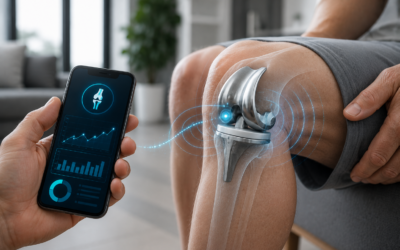
Biohacking Your Posture: Can Smart Wearables Really Replace a Spine Specialist’s Advice?
You’ve seen the ads: a sleek, pebble-sized device that sticks to your upper back, vibrating every time you slouch. In the high-tech corridors of Pune’s IT parks, “biohacking” your health with gadgets has become the new status symbol. But while your app gives you a “posture score,” is it actually protecting your spine, or just masking a deeper structural crisis?
Meet Neha, a 29-year-old UX designer working in Pimpri-Chinchwad. Neha is a self-proclaimed biohacker. She tracks her sleep, her macros, and most recently, her posture. After suffering from chronic upper back tension, she bought a top-rated smart wearable. For the first week, she was thrilled. The device buzzed, she sat up straight, and she felt like she was winning the battle against the “desk-slump.”
But three months later, the buzzing became a constant annoyance. More importantly, the sharp pain between her shoulder blades hadn’t disappeared—it had migrated to her lower back. Neha fell into a common trap: she assumed that monitoring a problem was the same as fixing it. She had the data, but she lacked the diagnosis.
The Rise of the AI Posture Guardian
The technology Neha used is part of a massive shift toward AI-integrated healthcare. Recent research into AI-powered posture monitoring systems highlights how sophisticated these tools have become. Utilizing sensors like the MPU6050 (accelerometer and gyroscope) and microcontrollers like Arduino or ESP32, these devices can detect the exact angle of your spinal tilt in real-time.
These systems are designed to address a global epidemic of “Forward Head Posture” (FHP). By sending data to a cloud-based app, they provide:
- Real-time feedback: Vibrations that act as “haptic reminders.”
- Data Analytics: Weekly reports on how many hours you spent in a “healthy” vs. “unhealthy” position.
- Preventative Alerts: Warnings before long-term muscle memory sets in.
While this level of biohacking is impressive, it operates on a “one-size-fits-all” logic. A sensor can tell you that you are leaning forward, but it cannot tell you why.
Why Your Wearable Can’t See the Full Picture
A smart device is a feedback loop, not a medical professional. Here is where biohacking hits a biological wall:
- It Ignores Structural vs. Postural Issues
A wearable assumes your spine is structurally sound and you are simply “lazy.” However, many residents in Pune seeking an Orthopaedic Surgeon in Pune are dealing with structural issues like scoliosis, disc desiccation, or Degenerative Arthritis. If your spine is physically unable to hold a “straight” position due to a disc bulge, a vibrating device won’t help—it will actually cause muscle fatigue and increased pain as you fight against your own anatomy.
- The “Compensation” Trap
When a device forces you to sit up straight, you might overcorrect by arching your lower back. This “compensatory posture” shifts the stress from your neck to your lumbar spine. Without a Knee, joint pain specialist in Thergaon to evaluate your overall alignment, you might be trading a neck ache for a future case of sciatica.
- Lack of Biological Depth
AI systems are great at tracking “angles,” but they don’t understand General Orthopedics. They don’t know if your posture is failing because of a magnesium deficiency, poor circulation, or early-onset Osteoporosis.
The Specialist’s Verdict: High Tech Meets Human Expertise
Biohacking should be a supplement, not a substitute. At Insight Bone Joint & Spine Clinic, Dr. Ashish Suryawanshi believes in using technology to empower recovery, but only after a clinical foundation is established.
A spine specialist offers what an algorithm cannot:
- Radiological Insight: Using X-rays or MRIs to see the actual state of your vertebrae and joints.
- Biomechanical Analysis: Checking how your Foot & Ankle alignment might be throwing off your pelvis and spine.
- Integrated Care: Identifying if your pain requires Mini-Invasive Orthopedic Surgery or if it can be managed through targeted Joint Preservation techniques.
How to Properly “Biohack” Your Spine Health
If you want to use technology to improve your posture, follow the “Specialist-First” Protocol:
- Get a Structural Baseline: Before buying a wearable, visit a specialist to ensure you don’t have underlying issues like Hand & Wrist Problems (Carpal Tunnel) or disc herniation that could be worsened by forced posture.
- Use Wearables as “Training Wheels”: Use the device for 2 hours a day—not 10. The goal is to build natural muscle memory, not to become dependent on a vibration.
- Prioritize Movement Over Positioning: A “perfect” static posture is still harmful if held for 8 hours. The best biohack is movement.
- Early Intervention for the Next Generation: If you notice your children slouching over iPads, don’t just buy them a gadget. Consult a specialist in Pediatric Fractures and growth to ensure their bones are developing correctly.
Conclusion: The Human Element of Healing
Neha eventually realized that her wearable was a tool, but Dr. Ashish Suryawanshi was the mechanic. After a thorough evaluation at our Thergaon clinic, she discovered that her “posture problem” was actually being caused by a hip misalignment that made sitting straight physically exhausting.
Technology is a window into our health, but a spine specialist is the one who can step through that window and fix the foundation. Don’t wait for your device to tell you there’s a problem—take control of your structural health today.
Are you relying on a gadget to save your spine? Stop guessing and start healing.
Book a consultation with Dr. Ashish Suryawanshi, the leading Orthopaedic Surgeon in Pune, at Insight Bone Joint & Spine Clinic.
Clinic Contact Information
- Name: Dr. Ashish Suryawanshi (Insight Bone Joint & Spine Clinic)
- Address: Shop 107 to 110, B-square, Barne corner, opposite atithi pure veg restaurant, Sainath Nagar, Sector No. 34, Thergaon, Pune, Pimpri-Chinchwad, Maharashtra 411033
- Phone: +91 9370671319
- Email: ashishvsuryawanshi@gmail.com
- Website: www.drashishsuryawanshi.com
Imp Services & Website Interlinking
- Orthopedic Trauma(Fractures)
- Degenerative Arthritis
- Joint Preservation & Replacement
- Hand & Wrist Problems
- General Orthopedics
- Pediatric Fractures
- Osteoporosis & Fall Prevention Awareness
- Foot & Ankle
Mini-Invasive Orthopedic Surgery
Recent Posts
-
Robotic vs. Traditional: Is the Extra Cost Worth It for Your 20-Year Joint Longevity?
-
 Beyond the Scalpel: Why Smaller Incisions in Robotic Surgery Lead to “Bounce-Back” Recovery
 -
 Smart Implants 2026: The Artificial Joints That “Talk” to Your Phone During Recovery.
 -
 The “Digital Twin” Advantage: How Dr. Ashish Suryawanshi Uses 3D Mapping to Rehearse Your Surgery
 -
 Biohacking Your Posture: Can Smart Wearables Really Replace a Spine Specialist’s Advice?