Robotic vs. Traditional: Is the Extra Cost Worth It for Your 20-Year Joint Longevity?
You’re facing joint replacement surgery, and the quotes are in. You see the standard traditional surgery cost, and right next to it, the slightly higher premium for robotic-assisted surgery. Your mind immediately asks the hard question: “Is a robot really worth the extra money?” If you want that new joint to last you two decades without a painful revision, the answer lies in the microscopic math of precision.
Meet Sanjay, a 62-year-old retired bank manager in Pune, whose passion for morning walks at the PCMC park was cut short by severe Degenerative Arthritis. When Dr. Ashish Suryawanshi suggested a total knee replacement, Sanjay was hesitant about the robotic option due to the initial cost. He wondered, “My father had a traditional replacement 15 years ago, and he did fine. Why do I need a robot?”
It’s a valid question. To answer it, we have to look past the surgery day and look 20 years into the future. Let’s break down the economics of longevity and why investing in precision upfront might be the most cost-effective medical decision you ever make.
The Myth of the “Standard” Knee
Traditional joint replacement is a highly successful procedure. A skilled Orthopaedic Surgeon in Pune uses alignment guides, experience, and visual judgment to remove the damaged bone and place the artificial implant.
However, the human body is not standard. Your bone density, the specific angle of your femur, and the tension of your ligaments are entirely unique to you. In traditional surgery, the surgeon aims for a “general” optimal alignment.
But what happens if the implant is placed off by just 2 millimeters or 2 degrees?
Initially, nothing. You’ll recover and walk. But over the next 10 to 15 years, that slight misalignment acts like a poorly balanced car tire. The uneven stress causes the polyethylene (plastic) components of the implant to wear down faster on one side. This leads to loosening, recurring pain, and eventually, the need for a complex, expensive “revision surgery.”
The Microscopic Math of Robotics
This is where the robotic advantage becomes clear. Research surrounding advanced surgical tracking, mirroring concepts found in databases tracking long-term orthopedic outcomes (like the principles discussed in advanced PubMed indices), emphasizes that the survivorship of an implant is directly tied to the precision of its placement.
When Dr. Suryawanshi utilizes robotic assistance for Joint Preservation & Replacement, the process shifts from “general alignment” to “patient-specific perfection.”
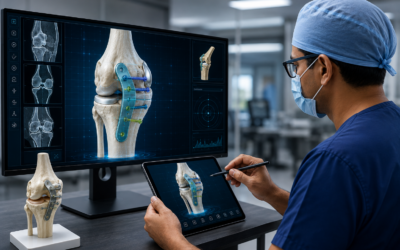
- The 3D Blueprint: Before the surgery, a CT scan creates a highly detailed 3D model of your specific joint.
- Virtual Balancing: The software analyzes the tension of your ligaments before any bone cuts are made, ensuring the new joint will feel natural and stable through its entire range of motion.
- Sub-Millimeter Execution: The robotic arm doesn’t act autonomously; it acts as an unshakeable guide for the surgeon. It locks the surgical saw into the exact pre-planned position, making cuts accurate to a fraction of a millimeter.
This level of Mini-Invasive Orthopedic Surgery ensures that the implant is balanced perfectly. The load is distributed evenly across the joint, drastically reducing the wear and tear over decades.
Calculating the True Cost of “Cheaper” Surgery
When evaluating the cost, you must consider the “lifetime cost” of the joint.
Let’s assume a traditional surgery costs slightly less upfront. If that joint fails at year 12 due to a 2-degree misalignment, you are looking at:
- The high cost of a complex revision surgery.
- Another period of prolonged rehabilitation and lost productivity.
- Increased surgical risks associated with operating on older, scar-tissue-heavy areas.
Investing in the robotic option upfront is essentially buying an insurance policy for your implant’s longevity. By securing sub-millimeter precision on day one, you are maximizing the probability that your new knee or hip will easily surpass the 20-year mark without issue.
Why Insight Bone Joint & Spine Clinic Champions Precision
At Insight Bone Joint & Spine Clinic in Thergaon, we don’t view robotic surgery as a luxury; we view it as the standard of care for patients demanding long-term mobility.
Dr. Ashish Suryawanshi, a leading Knee, joint pain specialist in Thergaon, understands that the residents of Pimpri-Chinchwad lead active, demanding lives. Whether it’s recovering from Orthopedic Trauma (Fractures) or seeking relief from chronic pain through General Orthopedics, the goal is a “one-and-done” intervention.
This commitment to precision extends across our practice, from managing delicate Pediatric Fractures to ensuring stability for seniors focusing on Osteoporosis & Fall Prevention Awareness.
The Verdict on Your 20-Year Joint
Sanjay chose the robotic option. Today, he’s not just walking; he’s trekking the local trails around Pune without a second thought about his knee. He paid a premium for precision, and what he bought was peace of mind for the next two decades.
If you are facing a joint replacement, don’t just ask about the price of the surgery; ask about the price of the implant’s lifespan.
Ready to invest in your long-term mobility? Consult with the premier Fracture specialist near me and discover the robotic advantage. Schedule your appointment with Dr. Ashish Suryawanshi today.
Clinic Information
Insight Bone Joint & Spine Clinic Shop 107 to 110, B-square, Barne corner, opposite atithi pure veg restaurant, Sainath Nagar, Sector No. 34, Thergaon, Pune, Pimpri-Chinchwad, Maharashtra 411033
Phone: +91 9370671319 Email: ashishvsuryawanshi@gmail.com Website: www.drashishsuryawanshi.com
Imp Services:
- Orthopedic Trauma(Fractures)
- Degenerative Arthritis
- Joint Preservation & Replacement
- Hand & Wrist Problems
- General Orthopedics
- Pediatric Fractures
- Osteoporosis & Fall Prevention Awareness
- Foot & Ankle
Mini-Invasive Orthopedic Surgery
Recent Posts
-
Robotic vs. Traditional: Is the Extra Cost Worth It for Your 20-Year Joint Longevity?
-
 Beyond the Scalpel: Why Smaller Incisions in Robotic Surgery Lead to “Bounce-Back” Recovery
 -
 Smart Implants 2026: The Artificial Joints That “Talk” to Your Phone During Recovery.
 -
 The “Digital Twin” Advantage: How Dr. Ashish Suryawanshi Uses 3D Mapping to Rehearse Your Surgery
 -
 Biohacking Your Posture: Can Smart Wearables Really Replace a Spine Specialist’s Advice?