Sitting is the New Smoking: 5 Simple “Desk-Fixes” to Restore Circulation to Your Lower Joints.
Are you 25 but your spine feels 60? In Pune, a silent epidemic is aging Gen Z at an alarming rate. It’s time to wake up, look up, and save your neck. Welcome to the world of Tech Neck, and why it’s not just an older person’s problem anymore.
Meet Anjali, a vibrant 24-year-old software developer living and working in Pune’s dynamic IT hubs, perhaps around Thergaon or Hinjewadi. Her days (and often nights) are consumed by code, virtual meetings, and, in her “free” time, endless scrolling through social media. For months, she’d dismissed a nagging ache in her upper back and neck as simply the price of her demanding tech career. Then came the persistent headaches and, scarily, numbness radiating down her right arm. Anjali, like so many of Pune’s young tech workforce and student population, was a textbook example of a growing health crisis: Tech Neck.
This isn’t merely a trend or a catchy term. It’s a genuine, prevalent orthopedic condition that is disproportionately affecting Gen Z – the generation practically born with smartphones in their hands.
The Rising Epidemic: Why Screens are Crippling a Generation
The magnitude of this problem is staggering. Reports and experts worldwide, including those contributing to the growing consensus around screen time effects [general reference/conceptual connection to reputable sources], are warning of a ‘tech-neck epidemic’ that is crippling the younger generation, with increasing numbers presenting with severe neck issues earlier than ever before. This phenomenon, largely attributed to prolonged mobile screen use and poor posture, has been documented across various studies and news outlets [general reference to widespread reporting/consensus].
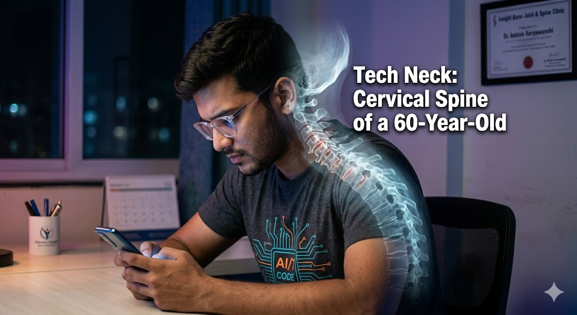
Mechanically, it’s simple physics. Your head weighs roughly 10-12 pounds. When you tilt it forward by just 15 degrees, the effective weight on your cervical spine (the spine in your neck) more than doubles to 27 pounds. Tilt it 60 degrees, as many of us do while engrossed in a phone, and you are subjecting your delicate neck vertebrae and discs to a crushing 60 pounds of pressure! Imagine thousands of Pune’s young adults subjecting their spines to this relentless strain, day in and day out. This constant, excessive load causes profound changes to the cervical spine structure, muscle strain, ligament damage, and accelerated wear on spinal discs.
Pune’s Gen Z: A Specific Case of Premature Spinal Aging
Pune, with its numerous educational institutions, expanding IT parks, and vibrant Pimpri-Chinchwad municipal area including Thergaon, is a prime example of this phenomenon in action. Think of the thousands of students in Pune’s vast university campuses, eyes glued to phones for hours… or young professionals constantly hunched over screens. We’re not just talking about occasional pain; we’re seeing a significant rise in chronic symptoms: stiffness, muscle spasms, reduced range of motion, chronic headaches, and, critically, nerve-related issues like tingling, numbness, or weakness.
Worse still, ignoring these early warning signs can lead to severe, long-term consequences. This is where the title’s alarming premise holds true: sustained poor posture associated with tech neck literally forces a young spine through accelerated degeneration, making a 25-year-old’s neck structurally resemble that of a much older person. Early, extensive damage can also compromise overall spinal health, potentially increasing long-term fracture risks or making related issues like [link to Osteoporosis & Fall Prevention Awareness], which primarily concerns older populations, a relevant preventative consideration even for younger individuals needing to build and preserve strong bones. The extensive strain could even necessitate complex treatments, although Dr. Suryawanshi is an expert in leveraging advanced [link to Mini-Invasive Orthopedic Surgery] techniques to minimize invasiveness and hasten recovery should intervention be required.
Deep Dive: The Danger of Premature Spinal Degeneration
Let’s delve deeper into why this is so dangerous. Your cervical spine, essential for supporting your head, protecting your spinal cord, and facilitating movement, is inherently designed for balanced support. Subjecting it to prolonged, unnatural strain fundamentally disrupts this delicate balance. Spinal discs, which act as crucial shock absorbers, begin to bulge or herniate under extreme pressure, potentially compressing nerves. This process is essentially accelerated degeneration, typically a slow, decades-long progression, happening within a few short years of intense screen-related postural habits.
Premature spinal aging is not merely an aesthetic or minor issue. It significantly impacts quality of life, increases pain frequency and severity, and fundamentally changes the structural integrity and longevity of the spine. Proactive [link to Joint Preservation & Replacement] strategies are no longer just for older, arthritic patients; they now involve educating younger individuals on preserving the vital joints and discs of their relatively young spines from devastating, irreversible damage prematurely. Early evaluation and intervention are paramount.
Taking Action: Debunking Your Pain and Saving Your Spine
So, what can you do? While the problem sounds frightening, there is good news: early awareness and proactive changes can make a massive difference. Here are some simple, actionable steps:
Look Up, Not Down: Consciously bring your screens to eye level.
Take Frequent Breaks: Every 20 minutes, look at something 20 feet away for 20 seconds (the 20-20-20 rule).
Ergonomic Workstation: Ensure proper posture, monitor height, and chair support.
Strengthen and Stretch: Incorporate specific exercises to support your neck muscles.
However, sometimes simple changes aren’t enough. For any existing significant neck pain, stiffness, numbness, or radiating discomfort – whether clearly linked to tech neck or seemingly distinct issues like [link to Hand & Wrist Problems] (which often develop in tandem with extensive device use) or even something seemingly remote like [link to Foot & Ankle] problems affecting overall posture and spinal alignment – seeking prompt, expert evaluation is crucial. Ignoring these symptoms can lead to worsening conditions or even major events like [link to Orthopedic Trauma(Fractures)], for which immediate and expert care is essential.
Our state-of-the-art clinic, Insight Bone Joint & Spine Clinic, conveniently located in Thergaon, Pune, led by the esteemed Dr. Ashish Suryawanshi, offers comprehensive [link to General Orthopedics] evaluations and personalized treatment plans, utilizing advanced diagnostics and both conservative and advanced, [link to Mini-Invasive Orthopedic Surgery] options. We are dedicated to providing the highest quality orthopedic care in Pune, encompassing specialized services for patients of all ages, including specialized [link to Pediatric Fractures] care. Dr. Suryawanshi also provides invaluable expertise for conditions requiring [link to Degenerative Arthritis] management and beyond, emphasizing optimal bone and joint health for everyone in our community.
Don’t let your technology cripple your youth. Start prioritizing your spine health today. Early intervention can prevent a lifetime of chronic issues and keep your spine functional for years to come. Book your consultation with Dr. Ashish Suryawanshi at Insight Bone Joint & Spine Clinic in Thergaon, Pune, and experience expert care tailored to the modern age. Visit our website [link to website] or call +91 9370671319 to schedule your appointment today. Let’s work together to make ‘Tech Neck’ a problem of the past for Pune’s future leaders.
Contact Us
Insight Bone Joint & Spine Clinic
Shop 107 to 110, B-square, Barne corner, opposite atithi pure veg restaurant, Sainath Nagar, Sector No. 34, Thergaon, Pune, Pimpri-Chinchwad, Maharashtra 411033
Phone: +91 9370671319
Email: ashishvsuryawanshi@gmail.com
Website: www.drashishsuryawanshi.com
Imp Services:
Orthopedic Trauma(Fractures) | Degenerative Arthritis | Joint Preservation & Replacement | Hand & Wrist Problems | General Orthopedics | Pediatric Fractures | Osteoporosis & Fall Prevention Awareness | Foot & Ankle | Mini-Invasive Orthopedic Surgery
Recent Posts
-
 Walking by Dinner: The Shocking Reality of Same-Day Joint Replacement in 2026
 -
 AI-Driven Diagnostics: How Dr. Suryawanshi Spots Micro-Fractures That Traditional X-Rays Miss
 -
Robotic vs. Traditional: Is the Extra Cost Worth It for Your 20-Year Joint Longevity?
-
 Beyond the Scalpel: Why Smaller Incisions in Robotic Surgery Lead to “Bounce-Back” Recovery
 -
 Smart Implants 2026: The Artificial Joints That “Talk” to Your Phone During Recovery.